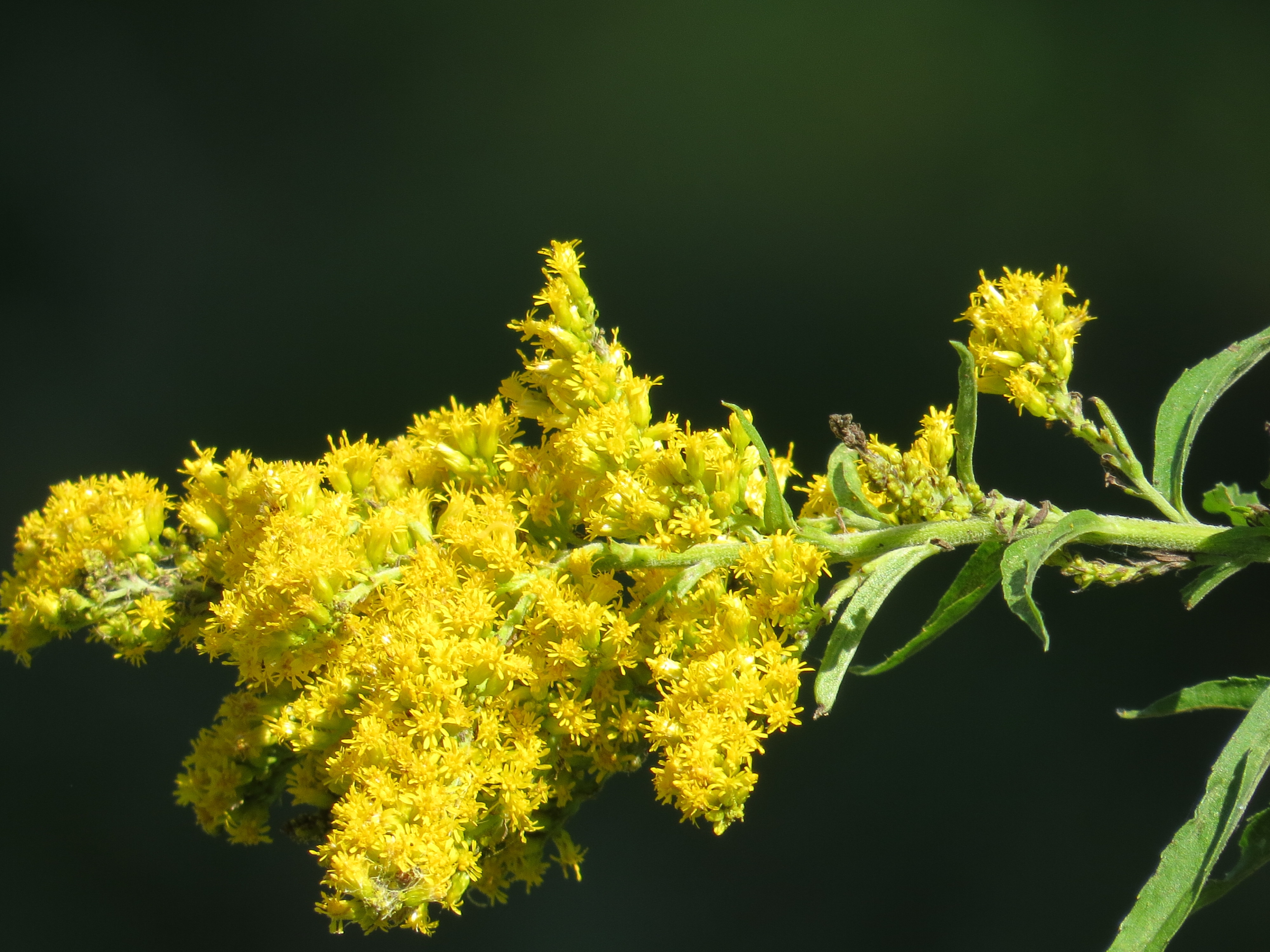
Goldenrods are in the daisy family (Asteraceae) even though they don’t look much like daisies. The old family name was Compositae, a clue that the flowers occur in clusters, and that what looks like a single flower (a daisy) is actually a composite (!) of several to many flowers. The family is huge and worth getting to know because it includes a vast array of species with a vast array of characteristics. We eat them (sunflowers), poison them (dandelions), get poisons from them (pyrethrins), use them as medicines (Echinacea), use them as décor (marigolds), curse them (ragweed), and can hardly get away from them (daisies).
Back to the flowers. Goldenrods produce an array of flower heads, each called a capitulum, and each containing several actual flowers. Those flowers around the edge of the capitulum are ray flowers (with elongated petals), and those in the middle are disk flowers (with tiny petals). In a daisy, the distinction is obvious: the ray flowers have big white petals and the disk flowers are bright yellow with hardly any petal tissue at all.
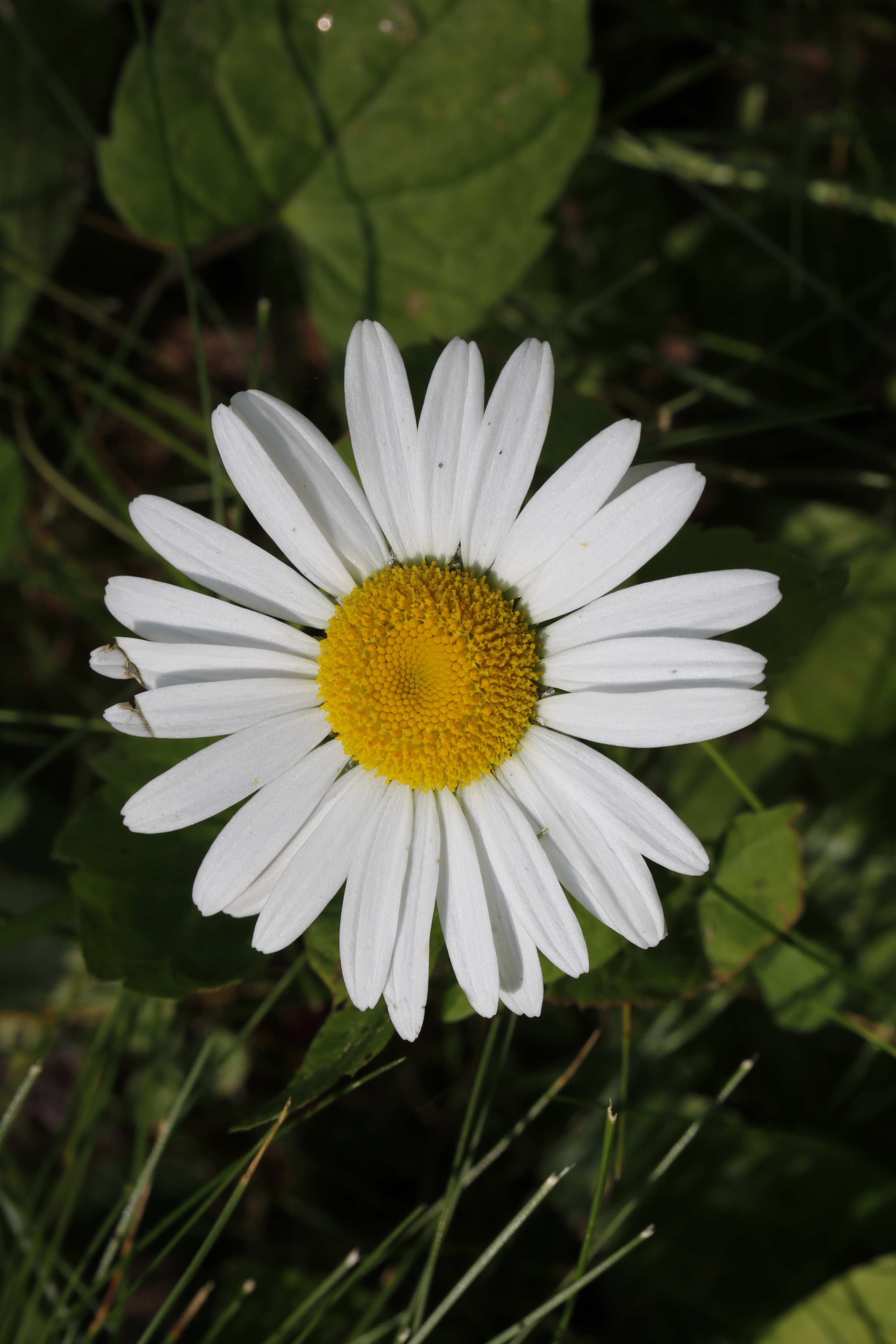
In goldenrods, you have to look closely to see the difference. The flowers are all the same yellow color (in most species), and the rays are not large. But they are there.

Each flower is tiny, but the collective display – in each head, and with all the many heads combined – is substantial.
According to Gray’s Manual of Botany, the ray flowers in each head are female only (pistillate), while the disk flowers are both male and female (staminate and pistillate). Early in blooming, the disk flowers don’t appear to be open, but the ray flowers are. Of course, the disk flowers have essentially no petals that it’s hard to tell, at first, what “open” means. But later, it becomes obvious (again, you have to look closely). Then the plants provide both nectar and pollen to the insects that visit. And the pollen gets distributed widely. Never doubt the power of group advertising.

 Owen Sholes
July 9, 2021 at 4:54 pm
How do the golden rod benefit from bees?
LikeLiked by 1 person
July 9, 2021 at 9:43 pm
Pollination of the flowers, resulting in seeds that gradually disperse from the plant.
LikeLike
September 10, 2024 at 6:48 pm
What is the process of death with this flower when the temperature begins to drops? How long does it take to die, does it drop its petals? Thank you for these blogs, I’m doing a research paper on these flowers!
LikeLike
September 10, 2024 at 7:04 pm
I don’t think that frost kills the flowers. Once the flowers are pollinated (there’s another post about that), each tiny flower forms one seed inside a dry fruit called an achene (there’s another post about that). As the seeds mature, the petals turn brown and shrivel. There are so many flowers on one goldenrod plant that the first flowers to bloom might have already produced seeds before the last flowers bloom. The seeds can blow away, but many stay on the plant when the stem and leaves die above ground. The seeds can fall off just about any time, and some might be there until spring. I have seen insects that eat the seeds (little caterpillars sometimes live among the flowers), and I have heard that some birds eat them. Most of the seeds fail to produce new plants, but a few might get lucky, sometimes after dispersing far away. Next year, another stem (or more) will grow from the roots and rhizomes that survive the winter underground. Does that help?
LikeLike
September 11, 2024 at 3:24 pm
That’s really interesting, thank you so much! This helps a lot!
LikeLiked by 1 person