Search

Owen Sholes

Living in the New England countryside

Category

Uncategorized

Dawn

dark sunrise

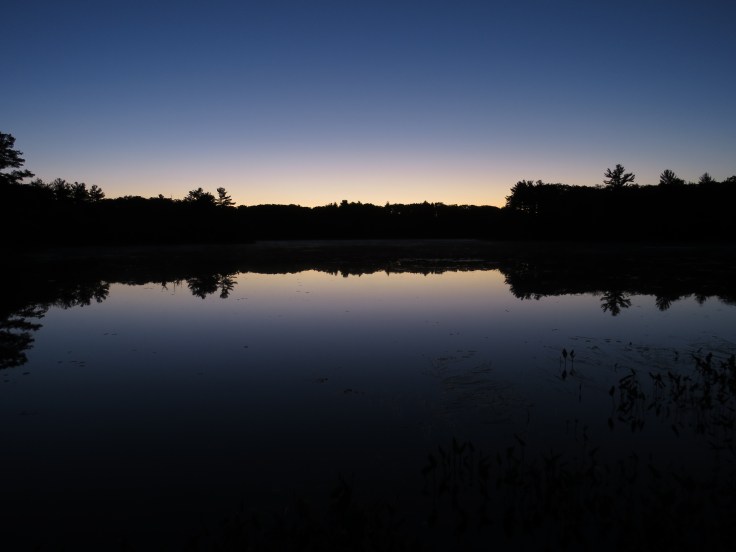
Yes, dawn happens every single day.  The sun rises, and we see what we see.  But I am awed by this stark simplicity, this beginning of another day’s light, this manifestation of a planetary cycle, of a star that keeps us alive, that makes possible our very existence.

This light also makes the pond possible.  It raises the waters into the sky that rain down and flow into the pond, day after day. How can there be so much water to sustain a pond?  Yet here it is, proof of the power of the sun and of the water.

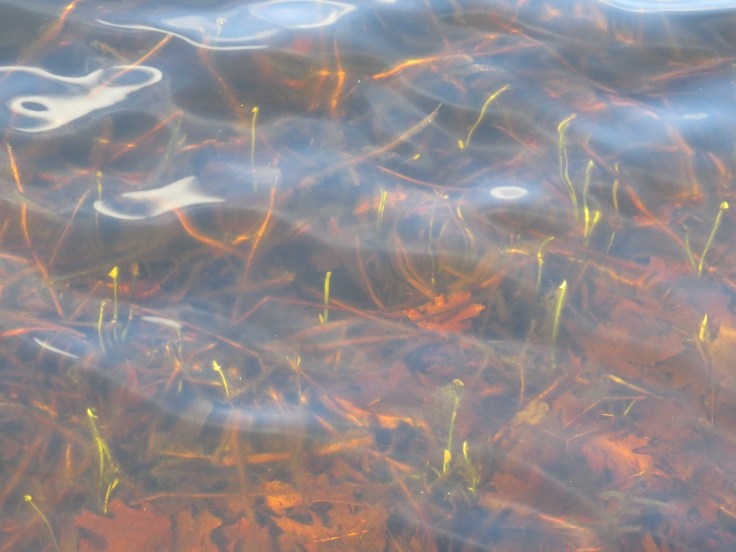
The light makes life in the pond possible.  It makes plants grow, with sunlight so diffuse and raw materials so rare that we humans have not found a way to replicate it.  But every single living thing in this pond, and around the pond, is a child of the light.  The plants grow. The animals feed on the plants, living or dead, or on other animals, or on the decay that is so clearly on display if you can see to the bottom of the pond.  They all grow with the light.

The light is rising, promising another day of life and growth.  And yes, also promising death and decay.  For it is a cycle, like the day and night, like the summer and winter, like the tides on a far ocean shore.  All that is alive here will, at some time, die.  But there is always something alive in the pond. Always.  Because there is light.  Every day, there is light.
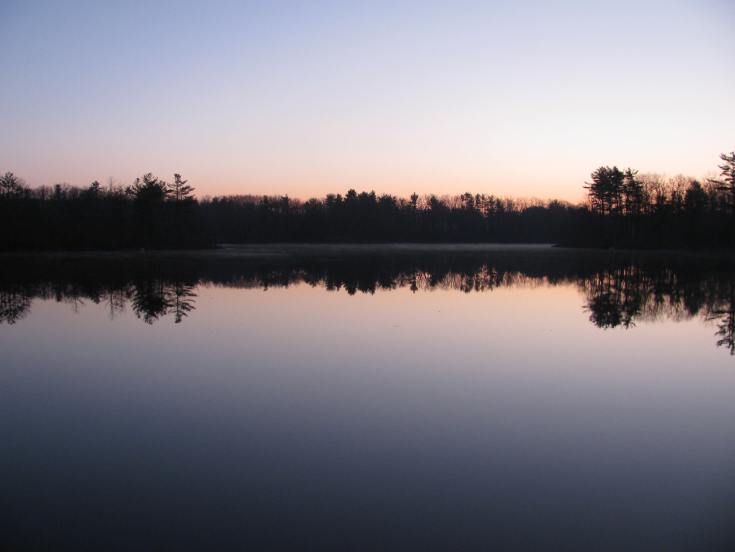
Clear

The sun is not yet up, the plants have not yet emerged, the wind is still, the sky is cloudless, and the pond is quiet.  Each of these qualities can change, quickly or gradually, and then the pond changes with them.

IMG_2288

The pond has no personality other than what we assign to it.  But its physical presence reacts to forces, both internal and external, and thus the pond appears to change its mood.  My mood is influenced by what mood the pond seems to have.  In some ways, I am a reflection of the pond.  It is part of my connection to my surroundings: the water, trees, soil, atmosphere, weeds, bugs, birds, neighbors and more.  The pond affects me, and teaches me, and I am content to let it do so.

The teaching began with this picture – it was the first sunrise photograph I took at the pond.

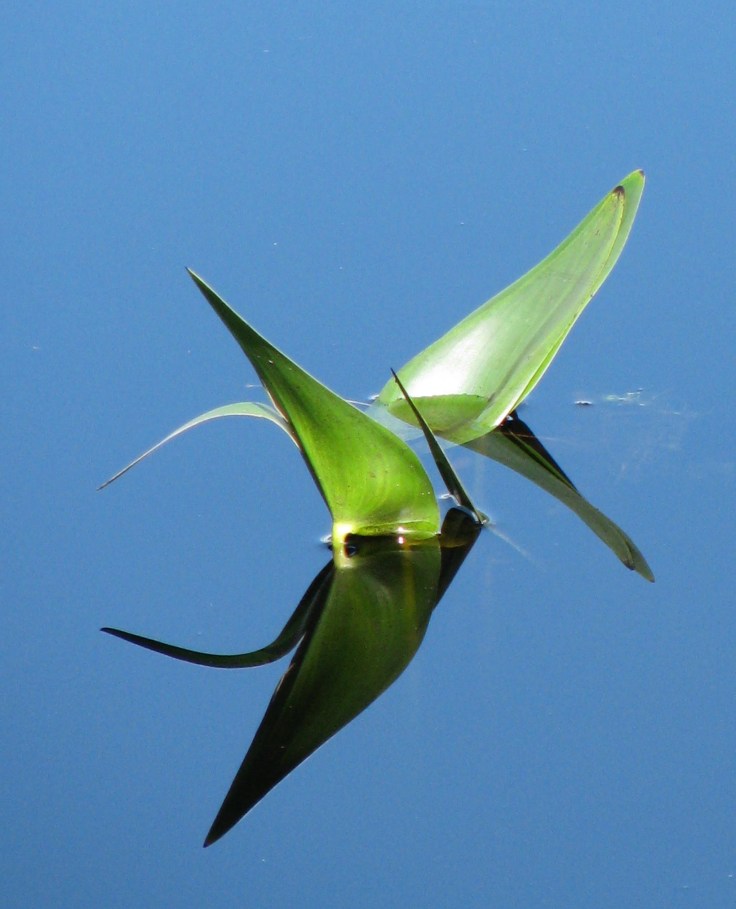
Pickerelweed

IMG_6212

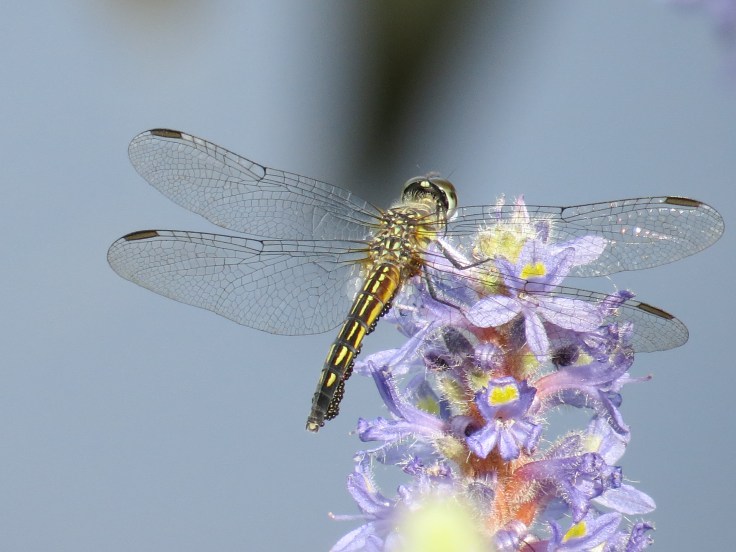
Emergent from the muck, the succulent green arrowheads point to the sun.  The leaves bask in the light, building reserves of sugar and starch deep into the rhizomes buried in the ooze.  This is the season of plenty, of excess and exuberance.  Lay down layers of tissue, the investment in the future. Other plants in your pond are content with floating on the surface.  Not you. You thrust into the sky and capture the light.  You are unafraid.

Roots below the water, lavender flowers raised above the pond, you give away your nectar and pollen in exchange for the services of bees.  Shallow-water show off, purple temptation, bounty of blossom, invitation to gluttony, sweet satisfaction.  Lure the insects away from the safety of land, promise them honey, make them mules for your yellow pollen grains, drug them, fatten them, send them off as surrogate lovers to fertilize that neighbor so tantalizingly out of your reach. Beholden to winged servants, you do whatever it takes to satisfy their needs, then make them beg for more, but from someone else, another of your kind.

Come autumn, you will sacrifice your tower and regroup in the firmament.  Sunk below the surface in October, you are fattened with stored goods, and you wait.  You won’t freeze because the coldest water is at the surface, not down there.  Your enemies, slowed by the cold, are not likely to find you.  They would have to dig to reach you, but they are just barely able to stay alive.  Such exertion is not an option.  But even if they did manage to find you, your sentinel epidermis is nasty and repellent.  Your layers of defense keep you safe.  Your patience keeps you alive.  Your savings guarantee your future.  When the sun is once more high in the sky, you will rise again.

IMG_4908


Buttonbush

IMG_4102
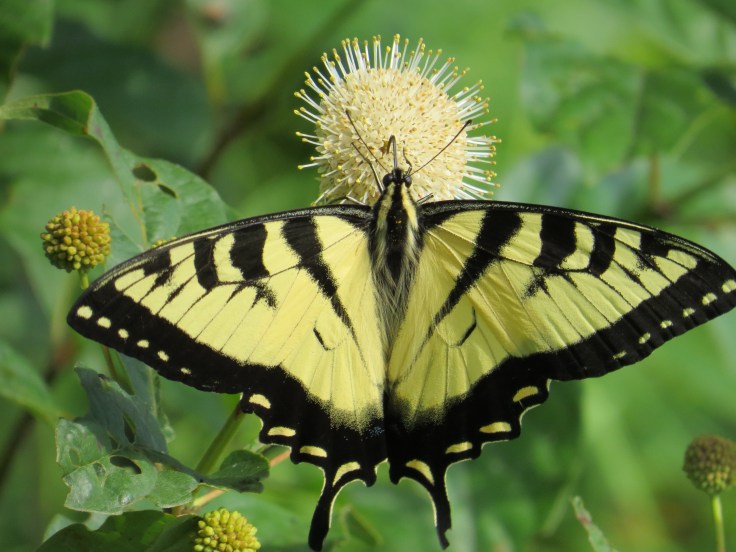
Tiger swallowtail (Papilio glaucus)

I couldn’t make sense of the flowers on this plant, but butterflies weren’t waiting for me to figure it out.  They alighted for extended visits, apparently finding lots of what they wanted. Nectar.  The flowers were an easily accessible width and length for a butterfly proboscis – uncoil, probe and drink.  The butterflies clung to the flowers long enough for me to get lots of pictures.

A colleague happened to see my pictures (one benefit of social media) and suggested that the shrub was buttonbush, Cephalanthus occidentalis.  With those names in hand, I quickly found pictures that matched what I was seeing.  (You were right, Karolina! Thank you!).  The plant was growing right at the edge of the pond, exactly the wetland habitat mentioned in all the references.

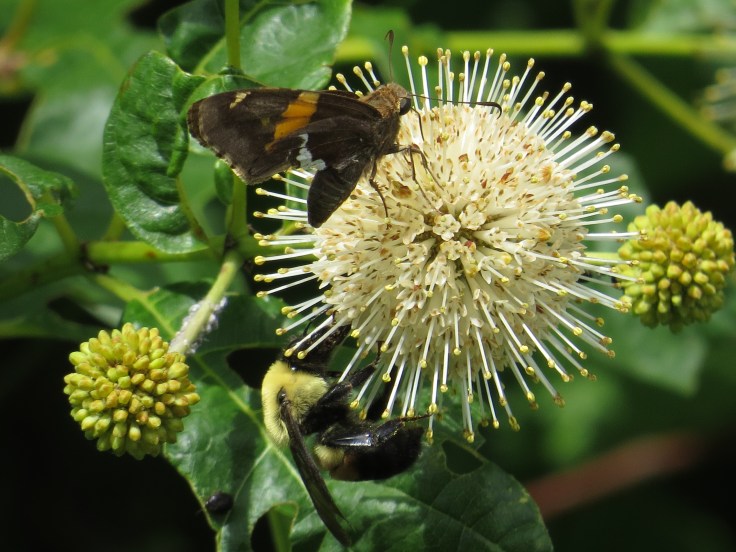
The buttons of the name are spherical clusters of many flowers, each flower a narrow white tube of petals with the pistil sticking out (some authors liken its shape to a pincushion.) The stamens are a bit shorter than the floral tube, so the flower depends on something like a butterfly to probe into the tube and pick up pollen from the anthers.  With so narrow a tube, the pollen is hard for a butterfly to miss.  The pollinators get nectar to fuel their flight and growth, and the plant gets pollinated when the greedy butterflies move to the next plant in search of more nectar.

If the shape and sweetness weren’t enough, buttonbush also has high levels of volatile chemicals that attract insects from afar.  Their perfume is complex, and it seems to be a good lure for passing pollinators.  And once the butterflies have landed, they just can’t seem to get enough of the goodness they have found.  They probe and probe among the flowers on each button, and only then do they move on to the next.

IMG_7910For the time that it flowers, buttonbush is an oasis near the pond.  There are flowers elsewhere, of course, but most don’t grab the attention of butterflies like buttonbush.  For a few days, it is the place to be.  But it won’t last forever, and thus the fervor of the butterflies is warranted.  Pollinators have to get what they can while they can.
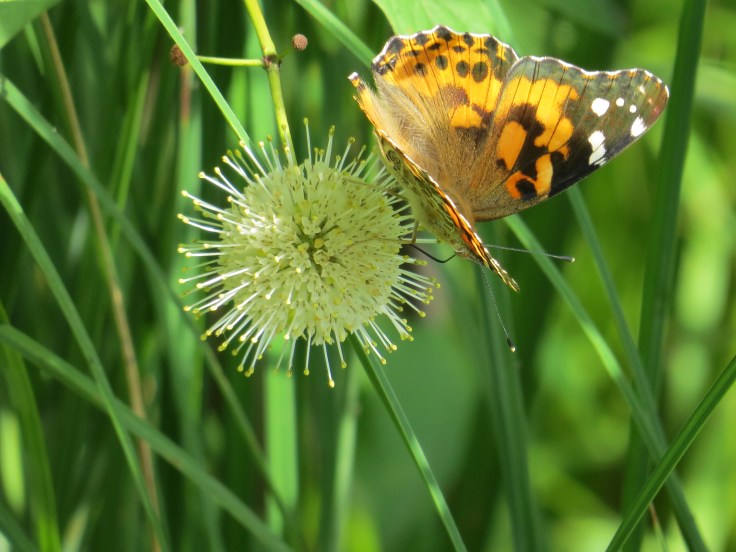
The interaction of flowers and butterflies seems to be working because there are more buttonbush plants this year than last.  We’ll see whether they can hold on to the precarious edge of land around the pond.  And we’ll see whether they can keep attracting butterflies.

IMG_4093
Painted lady (Vanessa cardui)

Swallows

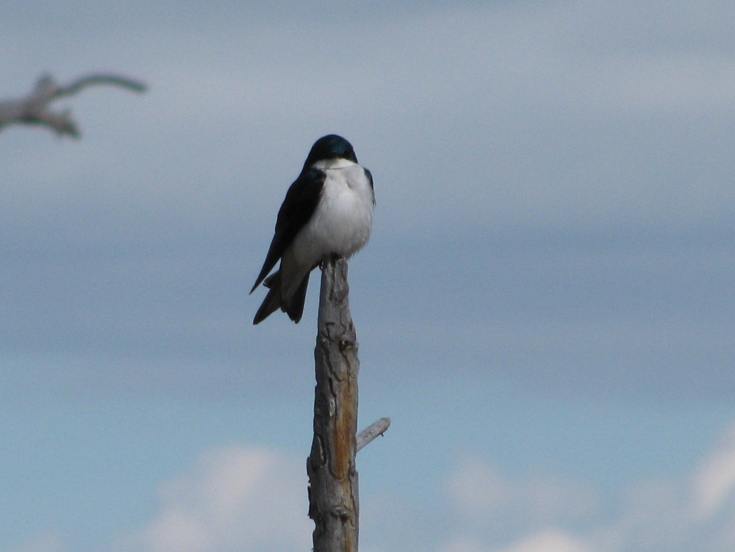
It was a comfortable evening near the end of June.  Around the outlet of the pond, where the stream tumbles down and flows below the road, over a dozen tree swallows (perhaps two dozen, but they were impossible to count) were circling and wheeling close to the pond, between the trees and above the road.  They were silent, yet agile, making frequent, rapid changes in course that hardly changed their velocity.  They spent much time gliding and turning, then flapping in bursts to gain lift, assisted by their considerable forward speed.

Dimples appeared repeatedly on the surface of the pond, signs of something on the surface, or breaking through the surface from water to air.  The swallows were not merely exercising, so the spreading circles must have been caused by an ongoing emergence of insects, probably something that was aquatic while immature but airborne as adults.  Having taken to the air in hopes of procreation, they had become the prey.  Too small for me to see above the water, the swallows seemed to find them easily, grabbing one and then coming back for more, and more, and more again.  In the few minutes that I watched, the flurry of flight did not let up.

There must have been hundreds, maybe even thousands, of lives lost in this encounter of swallows and prey, yet all I could see was the magnificence of birds.  So fast, so quick, so certain in their flight, with pointed wings and sleek bodies, the swallows were simply beautiful in my eyes. And I wondered: has there ever been predation more graceful than this?

tree swallow

A Pond

IMG_5347

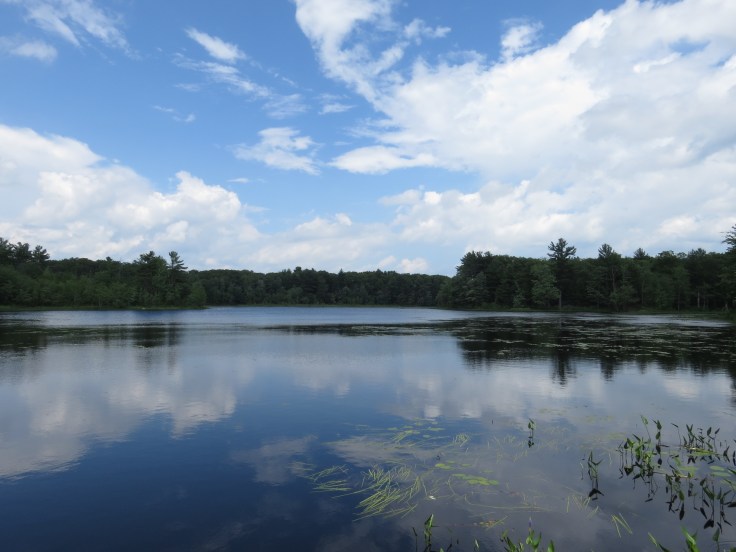
This is the pond at the end of my road in Rutland, Massachusetts.

There is no pond on the map from 1785, nor on the map from 1870 (I have a copy of that map).  In those years, only a stream runs from east of the Bigelow farm toward the Ware River.

There is a pond on the United States Geological Survey topographic map based on a 1938 survey. Sometime between 1870 and 1938, someone put a small dam in the stream and backed up the water.  A dam is still there, concrete and rusted metal, holding the pond in place.  Now, the outline of the pond changes only very slowly.

Water constantly flows through the notch in the dam, so it is not holding the same water in the same place.  New water arrives, old water leaves, the level changes little, but the water changes all the time.July dragonfly

The plants and animals of the pond don’t care which water molecules are present, just that there are always enough for them to make a living in and around the pond.

The plants and animals don’t care about me, either, even though I have lived down the road from the pond for forty years.  I am a casual visitor.  They are the residents.

The pond gives a sense of permanence.  It persists predictably enough that the living things match their cycles with those of the pond.IMG_7092

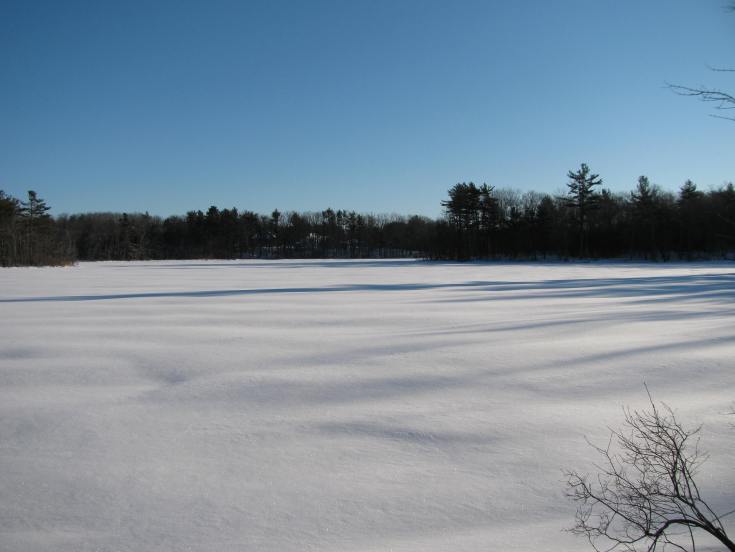
In contrast, the weather gives us pause, a pause revealed on the surface of the pond.  Will it be calm or rippled, bright or dark, liquid or solid, vibrant or shrouded?  Each day, each hour, each minute can differ from the last.

Each time I approach the pond, I expect to find some things and expect to be surprised by other things.

I do not walk around the pond because there is no path, there is much shoreline vegetation and there are many property owners.  Instead, I view it almost exclusively from one accessible vantage point.  It is a small window into what I find to be a surprising and fascinating place.  I want to explore how much that window will reveal.  Let’s take a look.

Blog at WordPress.com.

Up ↑