In December, 2008, a storm came through the Worcester Hills in north-central Massachusetts with rain that froze on every exposed surface, and strong, gusty winds. Many trees lost limbs, some were snapped off entirely, or were bent horizontal to the ground. We lost power for a week.
Later that winter, I tagged dozens of oak trees on our property and estimated the amount of damage that they had sustained. Four years later, I took samples from each tree and measured the thickness of their growth rings. Tree five, a red oak, lost forty percent of its canopy, and though its annual growth before the storm often produced rings about one millimeter thick (occasionally much more), in the years right after the storm, the rings shrank to about half a millimeter. The tree was struggling.
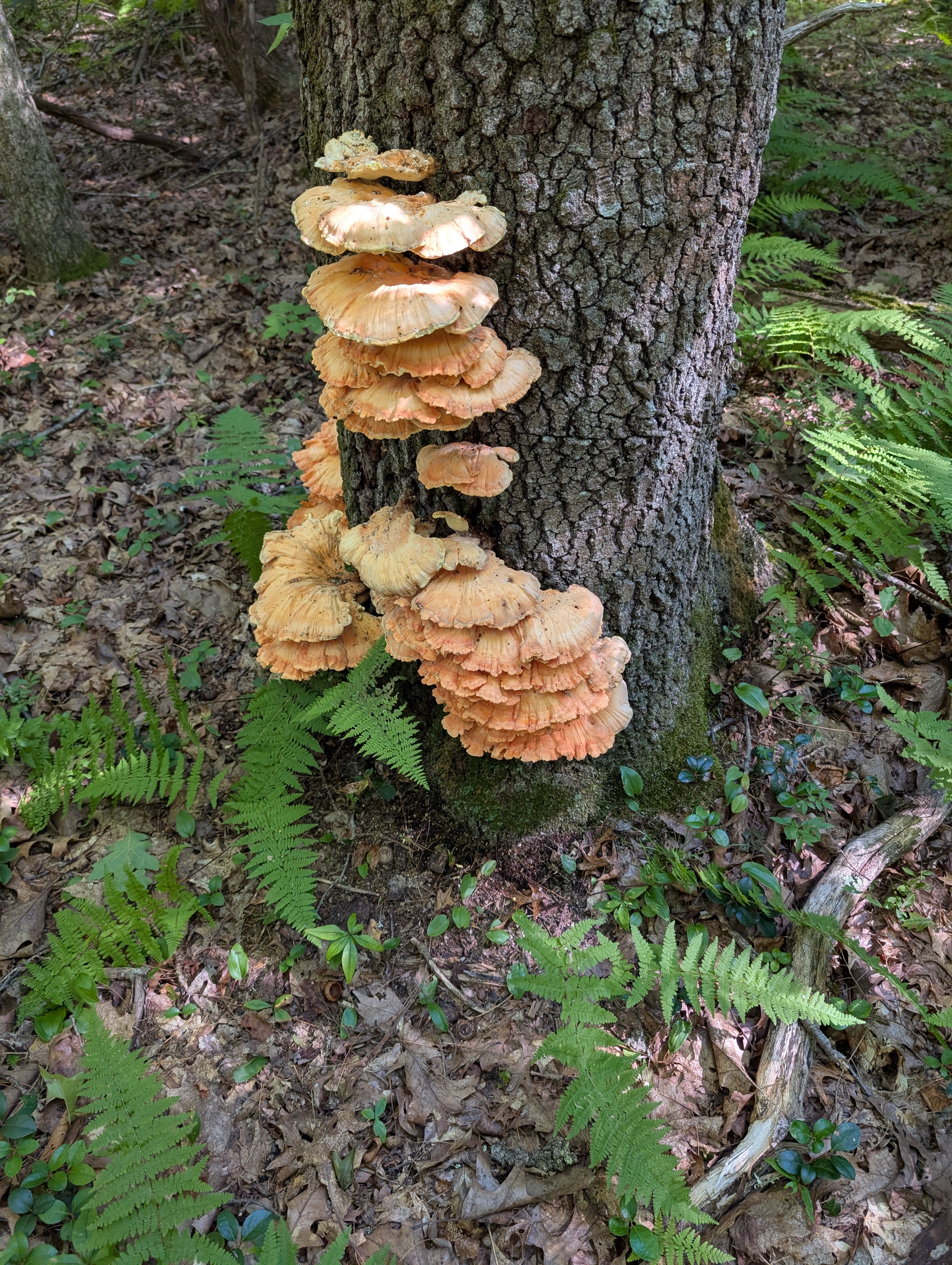
In 2025, seventeen years after the storm, tree five stood out among its neighbors because of a substantial growth of bright orange fungi. It still had leaves, but it also had disease. That is, disease from the perspective of the tree. From the perspective of the fungus, life was very good indeed.
It had been a while since I had walked among the trees I measured after the ice storm. I recalled passing easily through the woods, with fewer low branches than decades before, a moderate accumulation of fallen branches and trees, and a fair number of small white pines whose flexible branches were easy to brush aside. Today, there were more fallen branches, and many of the small pines had dead branches, sometimes all the way up, and they were stiffly resistant to my passage.
What was the source of the fallen branches? Even the ice storm hadn’t left this profusion of limbs. What would be the fate of the pines, still deep in shade, and now with fewer needles to support their growth?
The impression I felt was one of decline, of trees large and small shedding the branches they could not support. In recent years, there had been dry spells, sometimes lengthy ones, during which at least one large pine had died, and more than one had dropped major branches (one of which crunched our small barn). And while most of the trees damaged by the ice were still doing well, a handful were dying or dead, and tree five was unable to defend itself against invading fungi. The ice demanded a price.
Things were changing. Things always change. But these changes, this decline, reminded me of a line from Robert Frost: “… what to make of a diminished thing.”
I don’t know what to make of it. I need more time. I need to look at what remains more carefully to see a larger picture.
At least as things were diminished, there were flames of fungi emerging from the base of the tree, this still-living tree, not going gentle into that good night.
This winter, I will walk again, and see what I can make of it in the snow.
 Owen Sholes