Search

Owen Sholes

Living in the New England countryside

Category

Uncategorized

Spring Ducks

The ice is out, and even though there is the occasional snow, it is time for ducks to migrate through.  Some spend a couple of weeks, some just a few days.  Either way, they are finding things to eat when they dive, search, and swim after their food.

The largest group is ring-necked ducks, some of which come close enough to get photographed.  There are far more males than females, which is interesting or puzzling, depending on your perspective.  The males might be competing for attention and access, but they nearly always do so sedately, swimming in groups that part and reassemble, go from one edge of the pond to another, picking up the occasional stray individual.  They don’t do much diving, which suggests that courtship is the chief activity while they are on the pond.

There are other species of ducks, too far away for a good photo, but they appear to be buffleheads and common mergansers.  The buffleheads dive quickly, stay down quite a few seconds, then pop up like corks, their white heads conspicuous from far away.  The mergansers are the largest waterfowl here and their dives are more deliberate.  Even though there aren’t many on the pond, the males, with their distinctive white sides, black heads and orange bills, chase each other fairly often.  It is spring, after all.

These ducks will not stay long.  The call of the north is too strong, or maybe there are too many houses or too few nesting options here.  They will move on and try to produce another generation.  But the pond has been a good place to stop along the way.
Under the Ice

IMG_4695

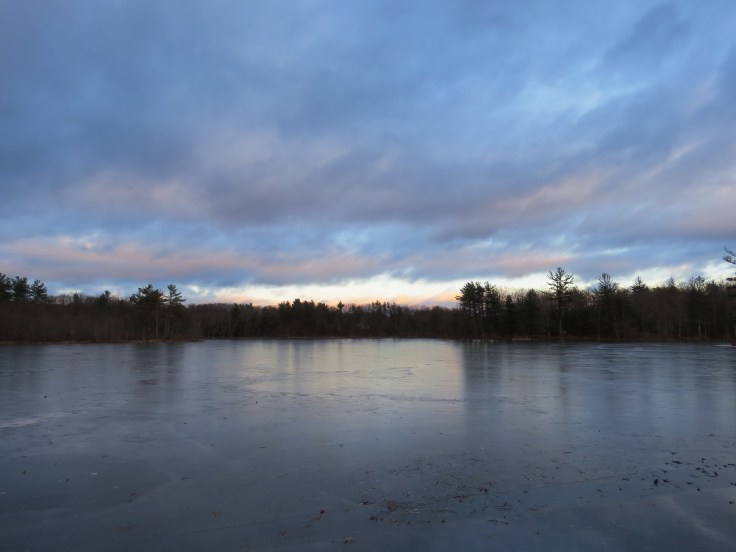
Can you imagine living under the ice?  Are you a fish, a crayfish, an adult beetle, a beetle larva, a dragonfly nymph, or a mayfly naiad?  The list is long and varied.  They don’t have to imagine living under the ice.  They do it.

Water is liquid below the ice, full of life, even if it is slowed by the cold.  The residents are not gasping for air or slipping into hypothermia (or if they are, it is an adaptation for coping with winter).  This is their world, cut off from the sky and the land, committed to the sealed pond.  Months go by without seeing the sun in full.  That is just fine with everyone involved.

Cold water holds more oxygen than warm water.  Cold water slows the metabolic rate.  In clean water, with little decomposition that depletes oxygen, life is well supplied.  The animals are not asphyxiated.  They could be said to thrive.

IMG_2048

The water will not mix with air again until spring melts the ice.  Myriad organisms are adapted for just such isolation.  Life cycles continue as programmed, and will do whatever it is that each species does come the thaw.

Until spring, ice shields the living things below from the frozen, dry air above.  Out of our sight, in a home that cannot be our home, a web of life carries on.  Hard to imagine?  That’s ok.

IMG_4718

Making Tracks

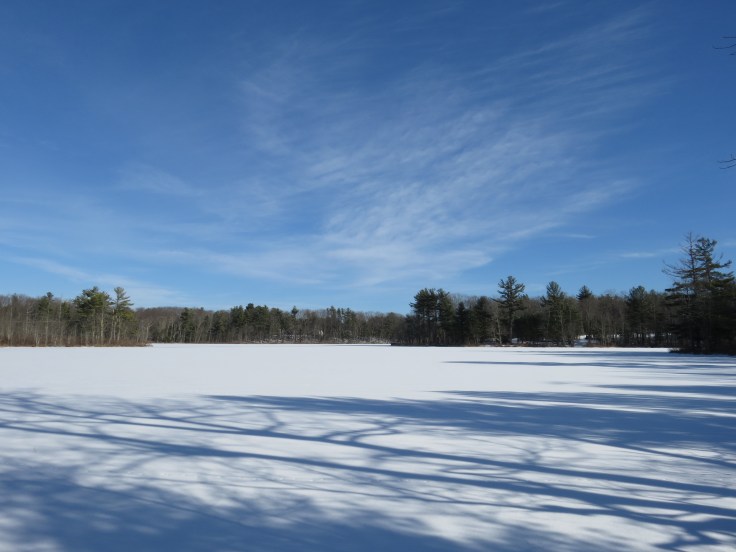
Winter has begun.  The frozen pond is graced with new snow, brilliant white except for shadows from the shoreline trees.

IMG_7301

Almost invisible in the sunlight, there are tracks through the snow, crossing the pond.  Some are small, some larger.  Something took a winter shortcut.

Small mammals dare not try to swim across the pond in summer.  Hungry fish and snapping turtles lurk below the surface.

Ice shortens their paths, saving time and energy.

But there is no cover on the ice.  Hawks could snag them before they reached the opposite shore.  The danger from above could explain why there are not dozens of tracks, just a few, representing the quick or foolish who dared to take the risk.  If they can reach the shadows, they might be alright.

Maybe they crossed at night, when hawks were perched and still.

But what about the owls?  There are owls in winter, too.  They are silent, and darkness is no protection.

Do you dash across the pond as a shortcut to food or shelter on the other side?  Or do you take the long way round and avoid having your life cut short by talons from the sky?

Winter offers new choices.  Choose wisely.

IMG_7302

Sinuous Ice

_MG_0506

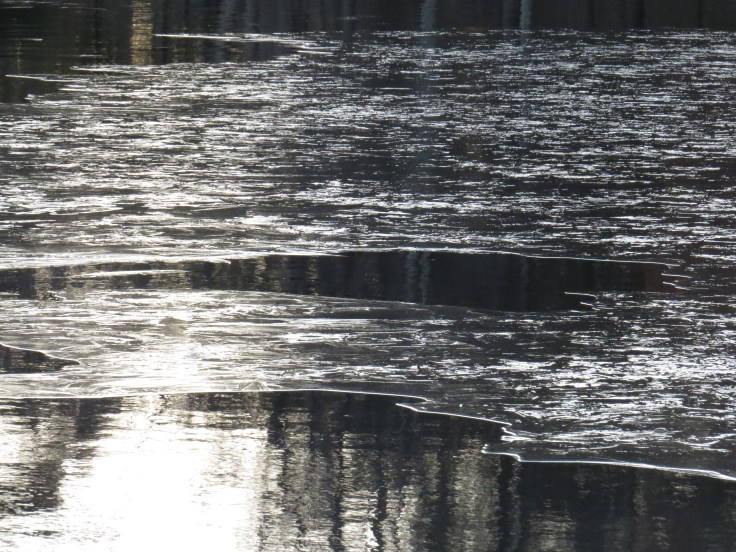
The pond surface is frozen and flat – and striped.  Somehow, the ice ended up with sinuous stripes across much of the pond.  They aren’t usually there, but sometimes they are conspicuously there, alternating in shade and sheen, meandering across and through the ice.

How do serpentine stripes form in the ice of a pond?

Does the wind make the water surface uneven as it freezes?  Does it drive rainwater into curved, parallel ridges as it freezes on ice that’s already there?  Do currents under the surface move, snake-like, in tandem below the freezing water?  Is there a combined effect of things above and things below the surface?

What causes the differences in appearance of the stripes, their brightness and reflection? Do the stripes differ in crystal structure, thickness, roughness, dissolved content, bubbles, particulates, or something else?  Perhaps if we examined the stripes closely and identified their physical differences, we would learn something about how they could have formed.

Whatever their origin, the patterns are striking, sweeping patterns generated without human planning or guidance.

Tonight, the ice is covered with water from two days of unseasonably warm weather and rain.  By morning, the temperature will drop below freezing as the wind blows.  Will there be stripes tomorrow?  We’ll see.

IMG_0391

First Ice

IMG_7263

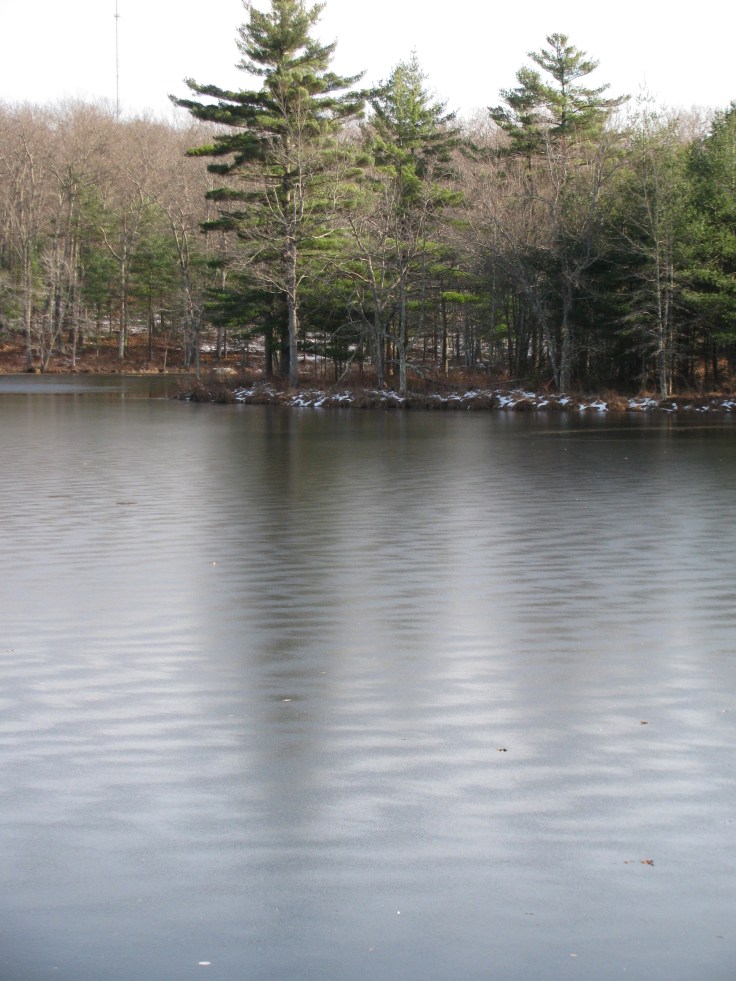
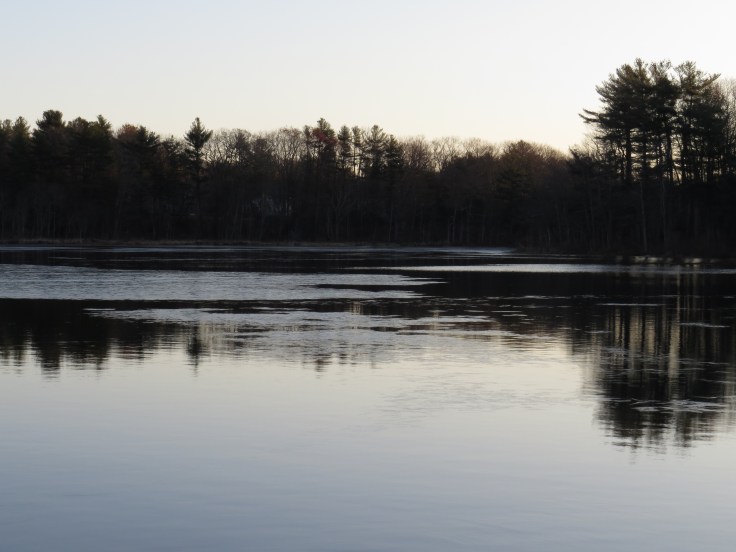
Clear as glass, the first ice of autumn glazes and graces the surface of the pond.  Wind ripples the open water, but not the ice.  Ice is calming, chilling, gripping, even when wafer thin and meters wide.  It might crack and form a floating veneer, a transparent iceberg, awaiting its fate in the new day.  Maybe sunlight will melt it back to water.  Maybe the chill will lock it tight to more ice, maybe where it started, or maybe on the other shore.

Starting last night, ducks were faced with a decision about the ice, and they divided into factions.  Some sculled their way within the open water, staying away from the ice, staying warm with layers of fat and feathers.  Others stood or sat on the solid surface of the ice, huddled against the chill.  Their feet are marvels of thermal exchange, keeping the warmth in the body core, letting the feet cool down. (How come the feet don’t freeze and fall off?  I don’t know.)

But unless my eyes deceive me, one group of ducks has found another option – floating on their legs.  These ducks are shin-deep in water in the middle of the pond.  They appear to be suspended, their feet invisible below the surface, but the rest of them quite stable above the surface.

How can they do that?  Though I can’t confirm it at this distance, they seem to be on ice so thin that their collective weight bends it down below the surface of the liquid water nearby. They have driven the solid below the liquid and are standing where no ducks should be, motionless, snoozing in the early light.  Duck density has struck a balance with ice buoyancy.

IMG_7269

Thus begins the winter interplay of ducks and ice, the open water shrinking, disappearing in the deepest cold, renewed in thaws.  The birds swim in the liquid, but hang out on the ice.  If the ice is wide and thick, they will leave for warmer places and return only when the water opens up again, probably in spring.  But today, spring is a long way off.

Autumn Fire

IMG_0209

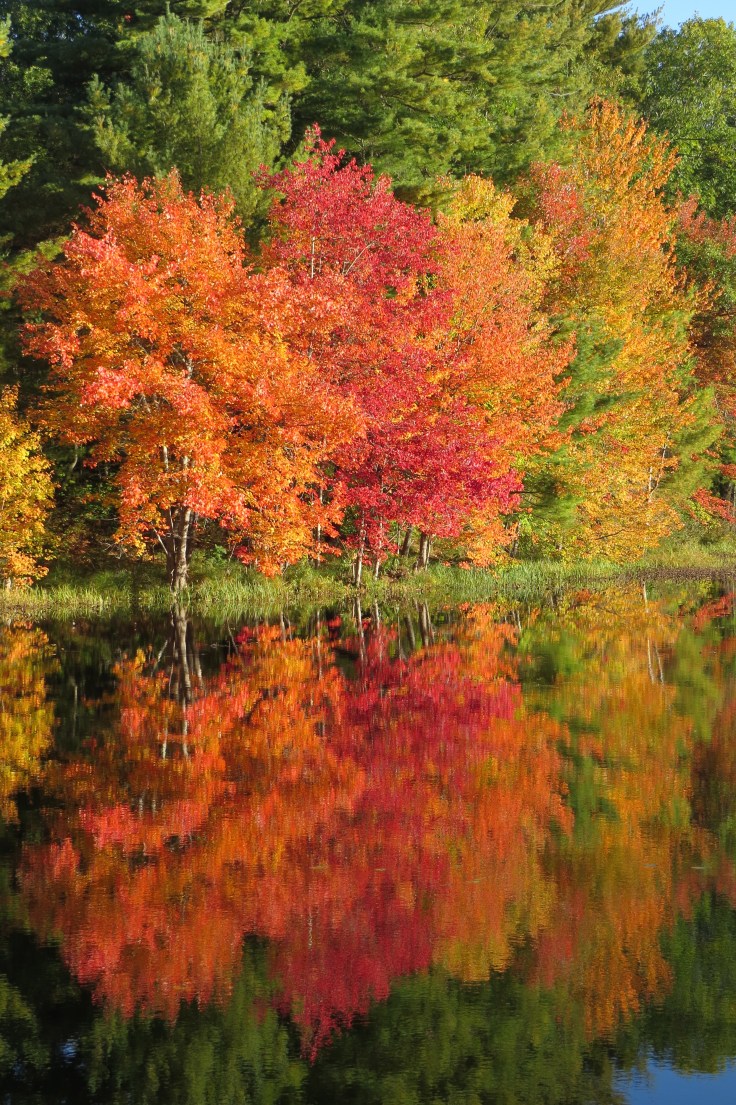
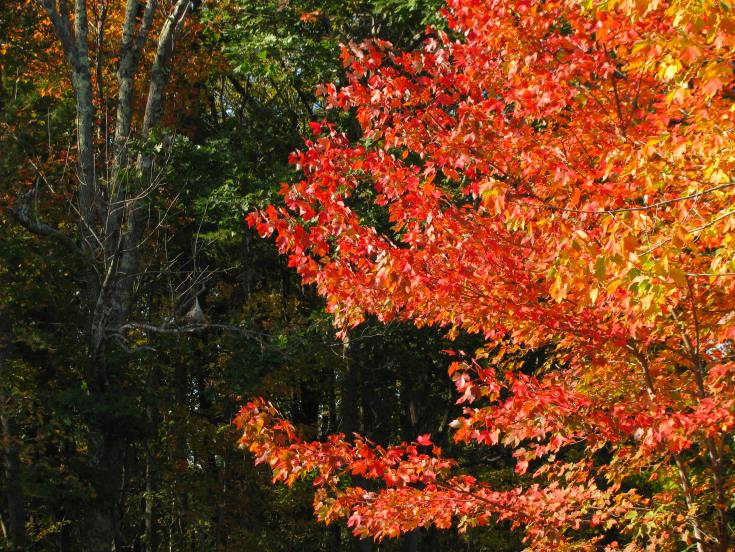
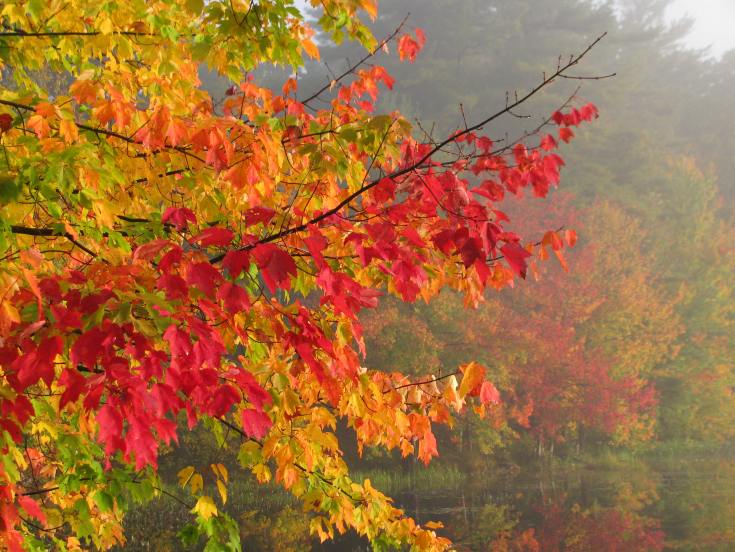
The pond in autumn is ablaze around the edge, flaming with orange, red and yellow.  It is fueled by trees, starting with maple and ending with oak. The leaves give up their green, so valuable for future growth, and send it back into the body of the trees. The hot colors are left behind.

pond maple

As the days shorten and cool down, the leaves heat up – or seem to.  I expect to feel heat on my face.  My eyes burn, but I cannot turn away.  People come from far away to see trees like these with shocking bright leaves.

The trees around the pond crowd the edge but cannot go in.  They ring the water, cast their shadows when the light is low, and show off their reflections in the middle of the day (as long as the water is calm).


In autumn, their colors and reflections border on blinding, ending the growing season in a blaze.  There aren’t vast swaths of trees around the pond, but their reflections double their glow, a two-for-one fire sale.

And the sale ends quickly, as gravity claims the leaves, a process hastened when wind and rain drive the leaves to the ground.  But for a few weeks, the autumn fire is spectacular.

Every year, they set themselves on fire.

And every year, they save themselves from the flames.

bright branch

Nymphaea

lily pads

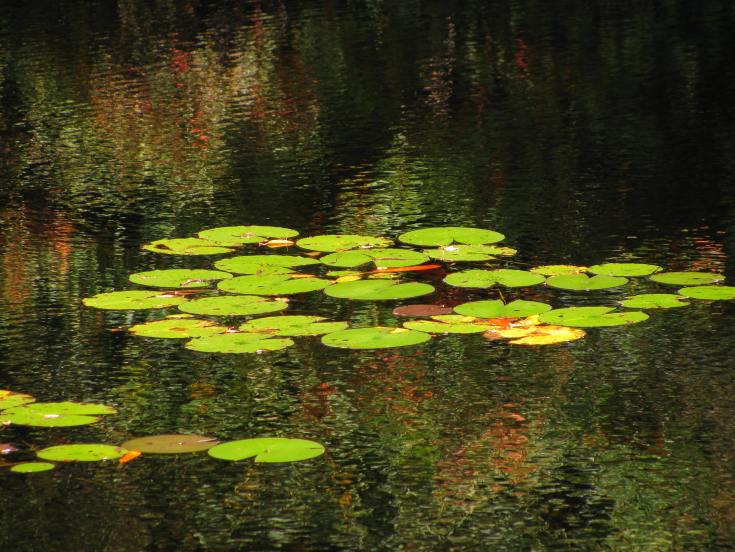
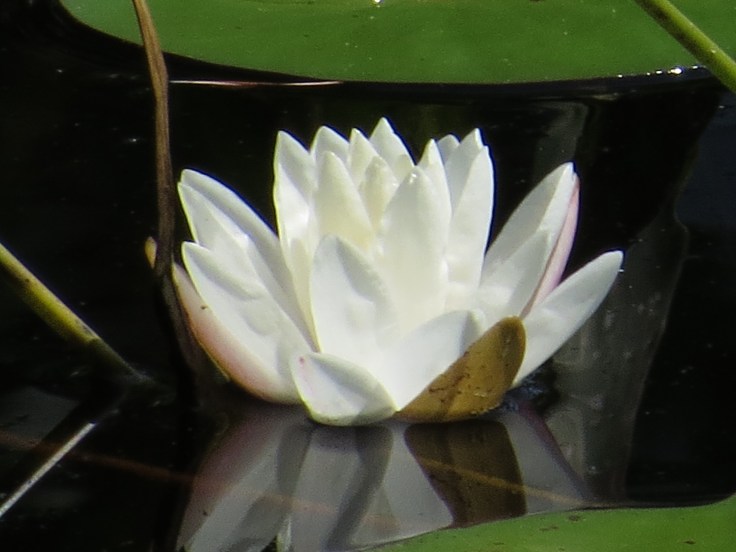
Leaves afloat, always right side up, exchanging air on top unlike nearly all other plants.

Flowers pristine and bright, beckoning pollinators from afar.

IMG_5542

We marvel that a plant rooted in ooze can make flowers so clean and white.

For Nymphaea, it is growth as usual.  They do it every year.


Beaver

IMG_3675

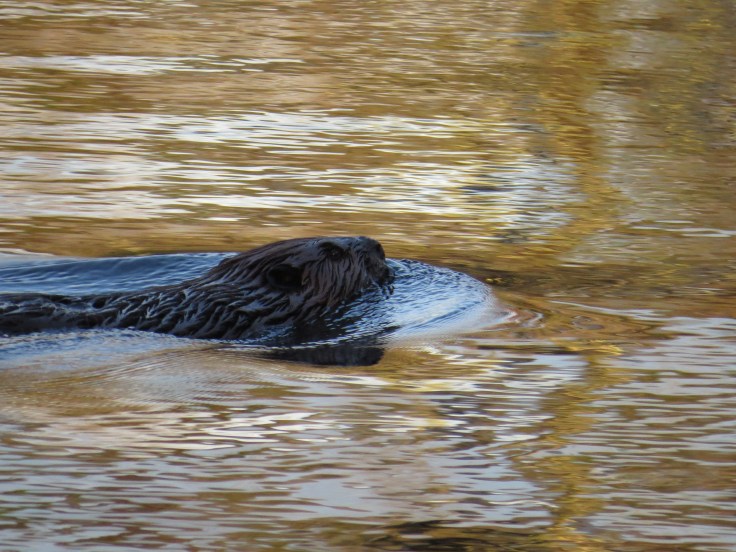
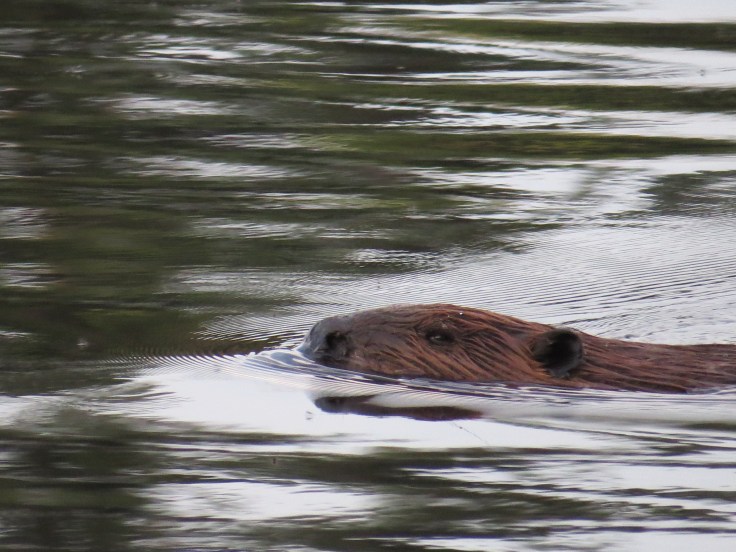
A beaver sometimes swims by the shore in the morning or evening.  The pond must be providing enough shelter and sustenance to sustain it.  There are green plants along the shore from spring through autumn, and plenty of trees to cut and set aside for the winter.  The water must be deep enough to cover the entrance to the lodge and to allow a dive when disturbed.

And the dam is already there.  No need to build another.  How much time and effort must that save for beavers?  The human subsidy frees them to forage, and maybe even to have a little down time. Do beavers ever take a break, or are they really always busy?  I’m guessing they rarely stop working because there is no telling how long the ice will cut off their food supply.  There is no telling how much food needs to be stored or consumed to build up body fat. Beavers sometimes have too little food in the winter, and they starve.  Life can be harsh.

But a ready-made dam probably increases the odds of success.  So do all the adaptations of beavers for living in a pond: teeth for cutting plants for food and construction, webbed feet for swimming, modified myoglobin to store oxygen while diving, and the layers of fur that repel water and maintain insulation year round.  Beavers have to occupy places that allow their adaptations to work. This pond is one such habitat.  And when it is sufficiently dark and there is no ice, there are beavers gliding through the pond, their eyes, ears and nostrils just above the surface.  Adaptation indeed.

IMG_3818

Two moons

There is only one moon orbiting the Earth.  Other planets have more moons, some of them many more, but we have just the one.  At least we aren’t moonless, like Mercury and Venus.

moon rise

The moon looks different each night as it moves in its orbit.  Sometimes, we can’t see it at all.  Two weeks after that, an entire illuminated face of the moon is shining in our direction.

When the moon appears in the sky, its light reflects on shiny surfaces: glass or polished cars or the surface of a pond.  A smooth surface generates a simple reflection.  It is bright and compact, and thus it resembles the moon

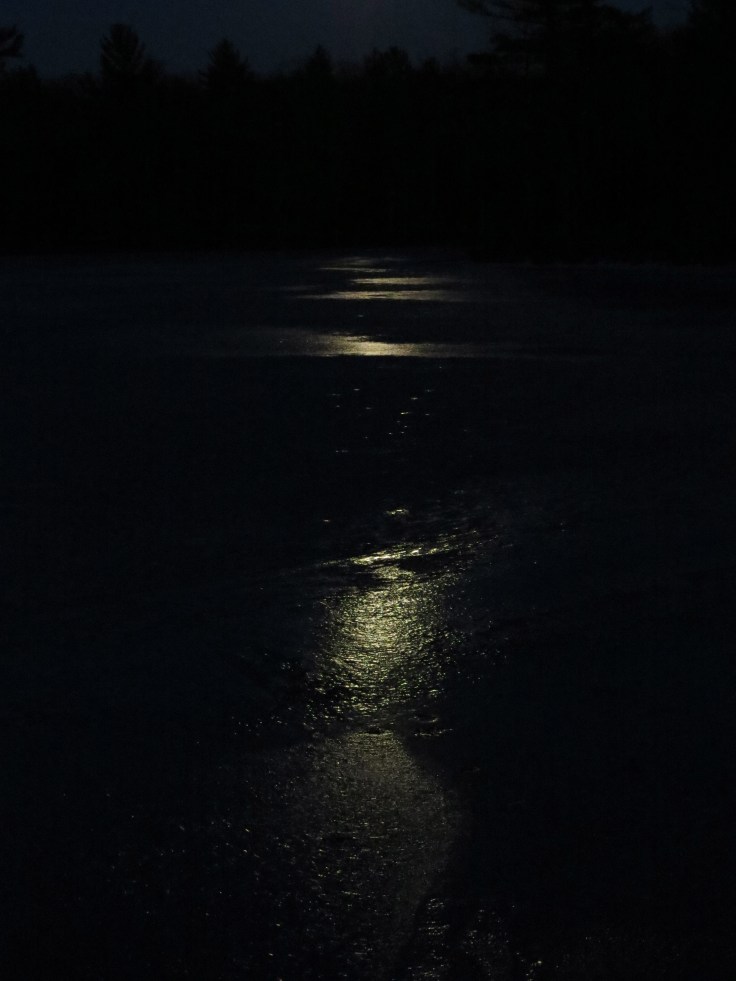
But the surface of a pond is not always smooth.  What happens then?  The water presents many angles to the light, and the light reflects in many directions.  A portion of each ripple will be at an angle to reflect light in my direction, so I will see a long, agitated and poorly resolved reflection of the moonlight.  It is soft, only an impression.

multiple reflections

Sometimes, the surface is smooth in one place where the wind has not reached it, and rippled where the wind has made contact.  Then there are two moons, one intense and condensed, the other soft and diffuse. And sometimes, there are more than two.

two moons

Of course, there is only one moon orbiting the Earth.  It merely appears as two (or more) on the complex surface of the pond. Goodnight, moons.

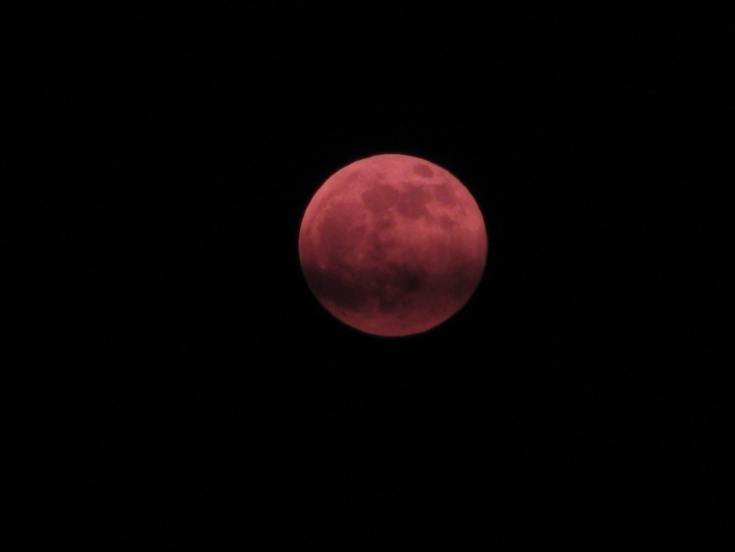
red moon

Blog at WordPress.com.

Up ↑